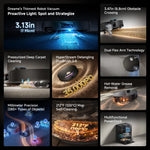
1.0 Mechanical Bumper
Physically triggered by contact. Features limited obstacle avoidance
range, easy damage to devices and furniture, and poor handling of
small/low/soft obstacles.
2.0 Line Laser + RGB
Uses reflected laser beams for object detection. Precise at close
range but fails to handle distant or low-lying obstacles and cannot
detect dark or transparent objects.
3.0 Binocular Stereo Vision
Employs dual cameras to perceive 3D space like human eyes. Accurately
detects even moving obstacles from near to far and performs reliably
in varied lighting, yet faces challenges in low-texture environments.
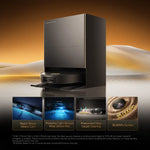
4.0 Dual AI Cameras + Projector
Two cameras combines projection technology to conquer low-texture surfaces. Maintains precise detection from 0.39in (10mm)* to long range, adapts to darkness or bright light, and responds instantly for dynamic navigation.
1.0 Mechanical Bumper
Contact-based navigation/avoidance: limited obstacle coverage, poor
small/low/soft obstacle handling.
2.0 3D Structured Light
Reflected laser navigation and detection: precise at close range but
lacks exact object recognition and automatic cleaning strategy
refinement.
3.0 AI Camera + 3D Structured Light
One camera with lasers identifies objects. Accurate up close, but
struggles with distance, low obstacles, and dark or transparent items.
4.0 Dual AI Cameras + Projector
Two cameras use projection for low-texture surfaces. Accurate from 10mm* to long range, adapts to darkness or light, and enables quick navigation.



 PM Series










 Robot Lawn Mower





 Australia
 中国大陆
中国大陆 日本
日本


 Türkiye


 Italia
 Netherlands
 Belgium
 Greece
 Polska
 Norway
 Sweden
 Finland
 Denmark
 Hungary
 Czechia
 Slovenia
 Croatia
 Switzerland
 United Kingdom
 Belarus
 Georgia
 Canada